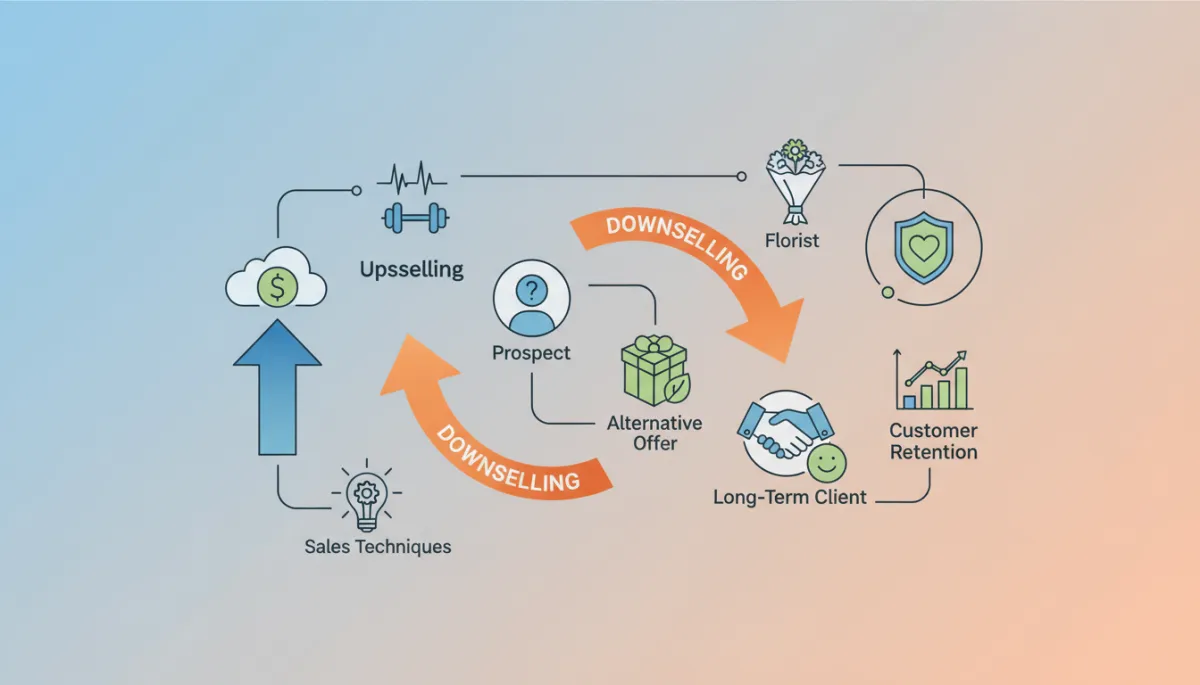
Downselling: Turn Prospects into Loyal Clients
Sales Strategy, Downselling, Local Business Growth
The Gentle “Yes”: How Downselling Turns Price-Shy Prospects into Loyal Clients
Somewhere between “no thanks” and “I’ll think about it” lives one of the most profitable words in your business: “actually…”. That’s the moment when a prospect hesitates, the price feels high, and you have a choice—let them walk, or confidently offer a thoughtful alternative that keeps them in your world. That, in essence, is downselling, and for established local businesses, it can quietly transform one-time inquiries into long-term, profitable relationships.
The Day a “No” Almost Walked Out the Door
Picture a Tuesday afternoon at a neighborhood training gym. It’s not a big-box chain—this is a locally owned gym, the kind where the owner still knows most members by name. A prospect, Lisa, walks in after work. She’s tired, stressed, and quietly worried about her health. She wants help, but she’s also watching every dollar.
The sales rep walks her through the premium membership: unlimited classes, personal training sessions, nutrition coaching—the works. Lisa nods along, clearly interested, until the price lands. Her eyes flicker, her shoulders tighten, and she says the line every local business owner has heard a thousand times: “I really like this… I just need to think about it.”
In many businesses, that’s where the conversation ends. A polite smile, a business card, a “Call us if you change your mind.” The prospect leaves, and the owner hopes they’ll come back. They usually don’t. The opportunity—and all the future revenue—walks out with them.
But this health club does something different. The rep leans in and says, “Lisa, I get it. Can I share a smaller option that might feel more comfortable to start?” She relaxes. Now we’re in downselling territory—offering an alternative product or service at a lower price that still moves the relationship forward instead of letting it end.
What Downselling Really Is (and What It Isn’t)
Downselling is the art of saying, “If this bigger commitment isn’t right for you today, let’s find a smaller, safer way to start working together.” It’s not discounting for the sake of desperation. It’s not slashing your prices to win a sale at any cost. It’s a deliberate sales technique built on three beliefs:
A smaller sale today is often more valuable than no sale at all.
Trust grows through experience, not just promises and proposals.
Long-term customer retention starts with giving people a way to say “yes” that fits their reality right now.
In simple terms, downselling is offering a thoughtfully designed alternative offer when a prospect hesitates on your main offer—something with less scope, less risk, or a lower price that still delivers real value and keeps the relationship alive.
💡 Pro Tip: Downselling is not apologizing for your prices. It’s confidently guiding prospects to the level of engagement that matches their budget and readiness today—without compromising your value.
Upselling vs. Downselling: Two Sides of the Same Coin
Most business owners are familiar with upselling: guiding a customer to a higher-priced option that better meets their needs. “Would you like to upgrade to our VIP package?” “Do you want the larger bouquet?” When done well, upselling increases the value of each transaction and can be a powerful revenue growth tactic.
Downselling is the mirror image. Instead of asking, “Would you like more?” you say, “Would you like to start smaller?” Where upselling maximizes the current sale, downselling protects the relationship when the big sale isn’t realistic—yet. Both are essential sales techniques in a healthy, well-designed sales process. Upselling grows revenue per transaction; downselling grows the number of relationships that can later turn into bigger, more profitable engagements.
“Upselling grows the size of the deal. Downselling grows the lifespan of the relationship.”
I often see owners lean heavily on upsells—bigger packages, more services, premium tiers—while leaving money on the table by not having clear, intentional downsell paths for good prospects who simply aren’t ready for the full solution today.
Health Club Story: From Lost Prospect to Long-Term Member
Let’s go back to Lisa at the health club. The premium package is too much—for her budget and her confidence. Instead of pushing harder, the rep offers a downsell option:
A basic membership with access to the gym floor and one group class per week.
A short, low-cost “starter program” with an orientation session and a simple four-week plan.
The price is comfortably lower. The commitment feels manageable. Lisa signs up. She starts showing up. She meets a trainer. She makes progress. Six months later, she’s the one asking about personal training and nutrition coaching—the very services she originally said she needed but couldn’t commit to on day one.

A thoughtful downsell today often becomes a higher-value relationship tomorrow.
Over two years, this “small” customer can easily become worth thousands of dollars in membership fees, upsold services, and referrals. Without a clear downsell strategy, she would have been a polite “no” and a lost opportunity. With one, she becomes a long-term, profitable member—and an advocate.
💡 Pro Tip: In membership-based businesses, downselling into a smaller recurring plan often produces more lifetime profit than chasing only the largest package buyers.
Florist Story: Saving the Sale Without Discounting Your Worth
Now step into a local florist’s shop on a Friday afternoon. A man walks in, clearly on a mission. “I need something nice for our anniversary,” he says, glancing at the large, premium arrangements in the cooler. The florist shows him a stunning, high-end bouquet. He loves it—until he hears the price. His body language shifts. He hesitates. You can almost see the mental math and the quiet worry about the week’s expenses.
This is the crossroads. The florist can either drop the price on the premium bouquet—undercutting their own margins and training the customer to expect discounts—or they can downswell with intention. So she says, “If you’d like to stay closer to this budget, I can create a smaller arrangement with the same style and a few of these premium stems. It will still feel special, just more compact.”
That’s a lower-priced alternative offer that:
Protects her margins (no discounting the original product).
Respects his budget and emotional reality.
Keeps the quality and style that made him say “wow” in the first place.
He says yes. His spouse is delighted. Next year, when the budget is a little better, he comes back—and this time, he chooses the premium bouquet without hesitation. Over time, he becomes a repeat customer for birthdays, holidays, and “just because” surprises. The florist didn’t just save a sale; she started a relationship by using downselling as a respectful, strategic move instead of a desperate price cut.
Why Downselling Matters for Established Local Businesses
If your business is already doing $500K–$5M in annual revenue, you’re not guessing anymore. You know your customers. You’ve built a reputation. You’ve likely added employees, upgraded your marketing, maybe even layered in some technology. And yet, like many owners we work with at Leon Beeloo, you may feel a persistent frustration: Why doesn’t more activity translate into more profit and more freedom?
One quiet reason is that your sales process might be too binary: either prospects buy the main thing, or they don’t buy at all. There’s no middle ground. No “start smaller.” No “let’s just solve this piece first.” That’s where downselling strategies earn their keep. They help you:
Capture more of the right prospects who genuinely want your help but can’t commit to the full solution yet.
Build trust and proof through smaller wins that lead naturally to larger engagements.
Improve customer retention by keeping people in your ecosystem instead of letting them disappear to a competitor or do nothing at all.
💡 Pro Tip: The most profitable customers often start small. A smart downsell is a bridge to your higher-value services, not a consolation prize.
Designing Downsell Offers That Protect Profit and Build Trust
Effective downselling isn’t random. It’s not “What can I throw in cheaper?” It’s a designed set of alternative products or services at a lower price that still align with your brand, your margins, and your long-term goals. Here’s a simple framework you can use in your own business:
Define your primary offer clearly. What’s the main solution you want most clients to buy? This might be your full-service package, your comprehensive program, or your top-tier membership.
Identify the core problem it solves. Strip away the extras. What is the essential result your client cares about most? Better health, a beautiful event, a reliable HVAC system, a clean house, a strategic plan?
Design a “starter” version. Create a smaller, simpler way to deliver a slice of that core result at a lower price point. Less scope, less time, fewer bells and whistles—but still real value. This becomes your primary downsell offer.
Set clear boundaries. Don’t quietly over-deliver your full premium experience at the downsell price. Document what’s included and what isn’t so your team can deliver consistently and profitably.
Build the upgrade path. Decide in advance how and when you’ll invite downsell customers to step up into your full offering once they’ve experienced a win with you.
When Leon Beeloo works with local service businesses, we often see that simply adding one or two well-structured downsell options—paired with a clear upgrade path—can meaningfully improve both short-term cash flow and long-term revenue without adding chaos or extra owner dependence.
Training Your Team to Use Downselling as a Confident Sales Technique
A downsell strategy is only as strong as the people using it. If your front desk, sales reps, or service advisors feel like offering a lower-priced option means “losing” the sale, they’ll avoid it—or worse, they’ll discount your main offer instead of using the designed alternative. You want them to see downselling as a professional, customer-centered sales technique, not a backup plan for weak closers.
Script the pivot. Give them simple language for that pivotal moment: “If this feels like too big a step right now, we have a smaller option that might be a better starting point. Would you like to hear about it?”
Clarify when to offer it. Not every prospect needs a downsell. Define clear signals: budget concerns, hesitation after hearing the price, or a mismatch between their readiness and the full solution.
Measure success by relationships, not just ticket size. Celebrate wins where a team member saved a sale with a downsell and later upgraded that client. Track the lifetime value of downsell customers, not just the initial transaction.
💡 Pro Tip: Role-play the “downsell conversation” with your team. The more natural it feels in practice, the more confidently they’ll use it with real prospects.
How Downselling Fuels Revenue Growth Without Adding Complexity
From a financial perspective, downselling is a quiet but powerful revenue growth tactic. It doesn’t require more leads, more marketing channels, or more owner involvement. It simply improves the yield on the opportunities you already have by converting more of your “almost yes” prospects into paying clients—then nurturing those relationships over time.
Higher conversion rates. When prospects have a lower-risk way to start, more of them say yes. Even a modest increase in conversion can create significant profit in a business your size.
More predictable revenue. A base of clients on smaller, recurring services creates a steadier foundation of cash flow that you can grow with upsells later.
Better use of fixed capacity. If your team, facility, or equipment has unused capacity, downsell offers can help fill it profitably without major new investment.
Most importantly, downselling aligns with a core belief we hold at Leon Beeloo: growth should increase profitability and freedom, not complexity and chaos. You don’t need a dozen new products or a complicated funnel. You need a clear primary offer, one or two well-designed downsell options, and a simple, accountable process your team can follow without you constantly stepping in.
Bringing It All Together: Your Next Steps with Downselling
Think back to the last few prospects who didn’t move forward with you. The homeowner who liked your HVAC proposal but chose “maybe next season.” The business client who loved your consulting package but couldn’t commit to the full scope. The family who wanted your premium landscaping plan but pulled back at the price. Each of those moments was an opportunity for a well-crafted downsell—an invitation to start smaller, prove your value, and earn the right to a larger engagement later.
As you look at your own business, ask yourself:
What is my primary offer—and do my team and I explain it clearly and consistently?
Do we have at least one intentional downsell offer—not a discount, but a smaller, well-defined alternative that still delivers real value?
Have we trained our team on when and how to present that downsell confidently, without apologizing or undercutting our worth?
You’ve already done the hard part—building a business that people trust, that delivers real results, that supports jobs and families in your community. Downselling is one of those quiet, strategic levers that helps the business you’ve built become more profitable, more predictable, and less dependent on you being in every single sales conversation.
Want Help Finding the Hidden Profit in Your Offers and Pricing?
If you suspect there’s more profit hiding inside the business you already have—better ways to structure your offers, price your services, and use strategies like downselling and upselling without adding more chaos—Pembroke Connections was built for owners like you. Our work is grounded in one simple goal: helping you build a business that runs with stronger systems, an accountable team, and less day-to-day dependence on you, the owner.
A powerful next step is to Take the Profit Acceleration Assessment. Bring three numbers—your annual revenue, gross margin, and operating profit—and in about 45 minutes, we’ll help you uncover where additional profit opportunities may exist in the business you’ve already built. You’ll walk away with a personalized Profit Acceleration Roadmap that highlights what deserves attention, how strategies like downselling and alternative offers fit into the bigger picture, and what to prioritize next so growth gives you more profit and more freedom—not just more complexity.
The next time a good prospect hesitates, you don’t have to watch them walk away. With the right downselling strategy in place, you can confidently say, “Actually… let’s find a way to start that works for you today.” That simple shift can turn more “maybe later” conversations into long-term, profitable client relationships—and move you one step closer to owning a business that truly works for you.