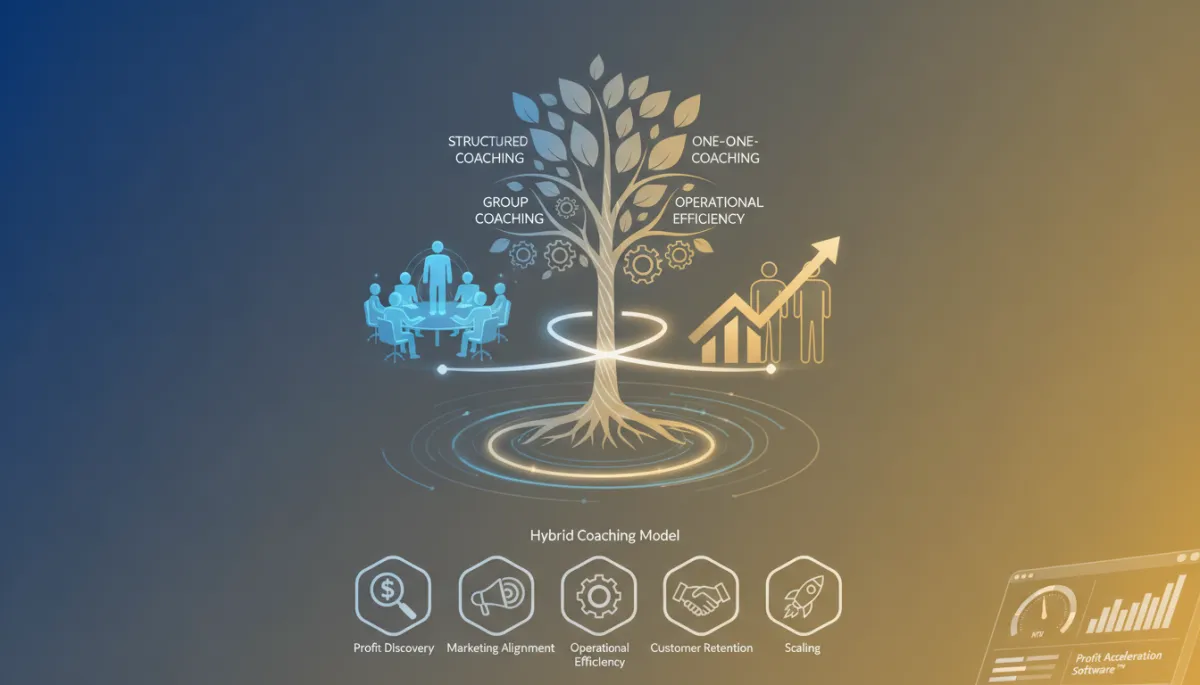
Boost Profits with the Right Coaching Format
Local Business, Service Business Profits, Coaching Programs
Service Business Profits: Choosing the Right Coaching Format to Build a More Profitable, Self-Sufficient Company
If your local service business is generating solid revenue but not producing the profit or freedom you expected, the issue usually isn’t effort—it’s structure. The right coaching format, backed by a clear profit-focused curriculum, can turn a busy, owner-dependent operation into a more profitable, predictable business that no longer relies on you for every decision.
Why Coaching Format Matters for Local Service Business Profits
Established local service businesses—contractors, specialty trades, home services, professional practices, agencies, and similar firms—often reach $500K–$5M in revenue through reputation, hustle, and the owner’s expertise. But at that stage, more growth can actually create more complexity, more staff issues, and more owner dependence without a matching increase in profit or freedom.
Coaching can absolutely change that trajectory—but only if it’s structured around measurable profit outcomes and delivered in a format that fits how your business actually operates. At Leon Beeloo, we see coaching formats not as “products” but as delivery systems for very specific profit improvements: higher margins, better capacity utilization, stronger team accountability, and a business that runs with less of you in every detail.
Comparing Coaching Program Formats: Group vs. One-on-One (and Why Hybrid Wins)
In 2026, coaching options for local businesses have expanded dramatically. Industry research shows the coaching market has nearly doubled in recent years, with the small business segment growing especially fast (coachingfederation.org; coachfactory.co). That means more formats to choose from—and more confusion. For a profit-focused local service business, the main decision is usually between group coaching, one-on-one coaching, or a hybrid of both.
Group Coaching: Shared Learning, Lower Cost, Powerful Perspective
In a group coaching program, a small cohort of owners meets regularly with a coach following a structured curriculum. For established local businesses, the right group can be a powerful profit accelerator because you:
Hear what’s working for peers in similar-sized service businesses—pricing moves, hiring strategies, and marketing plays you can adapt immediately.
Gain accountability from owners who understand the same pressures you face and won’t accept excuses when you don’t implement agreed actions.
Access a proven framework at a lower per-month investment than intensive one-on-one work, making it easier to stay engaged long enough to see compounding profit gains.
The trade-off is that group coaching, by design, can’t go as deep into the quirks of your specific team, local market, or financials during every session. You get a highly structured roadmap with peer support, but less individualized troubleshooting in the moment.
One-on-One Coaching: Deep Customization and Direct Accountability
One-on-one coaching focuses entirely on your business. Sessions are tailored to your specific numbers, team, and goals. For profit improvement, this format is ideal when:
Your financials are complex (multiple locations, service lines, or partners) and you need granular help with pricing, margins, and capacity planning.
You’re facing sensitive team or leadership issues that aren’t appropriate to unpack in a group setting but are blocking profit and scalability.
You want a coach who will challenge your thinking directly, help you make faster decisions, and hold you personally accountable to specific KPIs and commitments each week.
The upside is depth and customization. The downside is cost and capacity—purely one-on-one programs are typically more expensive and can’t leverage the peer-learning advantages that modern coaching research highlights as key to scalable results (themethodlab.co).
The Hybrid Coaching Model: Best of Both Worlds for Profit and Freedom
For established local service businesses, the most effective approach we see at Leon Beeloo is a hybrid coaching model: structured group sessions to teach and implement the core profit systems, combined with targeted one-on-one sessions to customize, troubleshoot, and go deeper where needed.
A well-designed hybrid program gives you:
Structure: A clear, week-by-week syllabus that walks you from profit discovery to scaling, ensuring nothing critical falls through the cracks.
Community: A small, curated group of owners facing similar challenges, so you learn from real-world examples and see that you’re not alone in your struggles.
Customization: One-on-one sessions to adjust the frameworks to your team, market, and numbers—and to push you past bottlenecks faster.
This hybrid approach aligns with broader 2026 coaching trends, where hybrid and blended formats dominate—combining live coaching, digital tools, and structured curricula for both depth and scalability (s3.amazonaws.com 2026 Coaching Industry Report).

Hybrid coaching blends peer learning with tailored guidance to unlock hidden profit.
Why Structured Coaching Beats “Random Advice” for Measurable Profit Results
Many owners have already tried some form of coaching, mastermind, or ad-hoc consulting. The problem is not a lack of ideas—it’s the lack of a coherent system that links those ideas to your P&L, capacity, and team behavior in a measurable way. Without structure, coaching can become another activity that consumes time but doesn’t reliably move key numbers.
Structured coaching, by contrast, is built around:
A defined profit roadmap with milestones and deliverables—such as a pricing model, marketing scorecard, capacity plan, or retention system—tied directly to financial outcomes.
Clear KPIs (key performance indicators) that are tracked weekly or monthly, so progress and bottlenecks are visible and not based on feelings or hunches.
Tangible deliverables—documents, dashboards, scorecards, and playbooks—that stay in your business long after the coaching engagement ends.
At Leon Beeloo, we anchor this structure with tools like KPI tracking dashboards and Profit Acceleration Software™, which provide a quantified view of where profit is leaking and where it can be recovered. This shifts coaching from “good conversations” to measurable financial transformation.
Inside a Profit-Focused Coaching Series: Week-by-Week Syllabus
To make this concrete, here’s a sample 12-week profit-focused coaching series designed for established local service businesses. In a hybrid format, most weeks include a group teaching and implementation session, plus optional or scheduled one-on-one time for deeper work on your numbers and team.
Week 1–2: Profit Discovery and Baseline Clarity
Everything starts with clarity. Most owners know revenue and perhaps net profit, but not the specific levers that drive profitability. In these first two weeks, we focus on Profit Discovery:
Review your last 12 months of financials to clarify revenue by service line, gross margin, and operating profit.
Use Profit Acceleration Software™ to run a diagnostic that highlights hidden profit opportunities and the cost of inaction over the next 12 months (go.focused.com).
Establish a core KPI set—typically including lead volume, conversion rate, average ticket, gross margin, labor utilization, and owner hours worked in the business.
Deliverables: a Profit Baseline Report, KPI dashboard template, and a first-pass Profit Acceleration Roadmap showing where your biggest immediate gains likely sit.
Week 3–4: Marketing Alignment with Profitable Customers
Many local service businesses unintentionally market to the wrong customers—price-sensitive, scope-creeping, or low-margin segments. In Weeks 3 and 4, we align your marketing with your most profitable work, not just the loudest demand:
Identify your top 10–20% most profitable customers and jobs using your gross margin data and capacity impact, not just revenue size.
Clarify your “Profit Sweet Spot” services—where you do great work, margins are healthy, and your team can deliver consistently without owner firefighting.
Adjust your messaging, offers, and lead qualification so your marketing attracts more of those ideal, profitable customers and filters out poor fits earlier.
Deliverables: a Profit-Focused Customer Profile, a refined offer stack, and a simple marketing scorecard tied to lead quality and conversion, not just volume.
Week 5–6: Operational Efficiency and Capacity Utilization
At $500K–$5M in revenue, operational inefficiencies quietly erode profit—technicians underutilized, owners jumping into jobs, scheduling gaps, and rework. In Weeks 5 and 6, we focus on operational efficiency:
Map your core service delivery process from lead to payment, identifying bottlenecks, handoff gaps, and owner-dependent steps that slow everything down.
Introduce simple capacity and scheduling metrics—such as billable hours percentage, on-time job completion, and rework rate—to track operational health weekly.
Use Profit Acceleration Software™ implementation planning features to assign operational improvement tasks to specific roles with deadlines and accountability (go.focused.com).
Deliverables: a streamlined service delivery map, an operations KPI set, and a 30–60 day implementation calendar with owners assigned to each action.
Week 7–8: Customer Retention, Lifetime Value, and Referrals
Acquiring new customers is expensive. For most local service businesses, the fastest and least risky profit gains come from improving retention, repeat business, and referrals. In Weeks 7 and 8, we build a simple but robust retention engine:
Analyze your current customer base to identify repeat purchase patterns and gaps where customers drift away after a single job or season.
Design a basic but consistent follow-up and nurture rhythm—check-ins, maintenance plans, seasonal offers, or service bundles that increase lifetime value without discounting your expertise.
Implement a referral system that is easy for customers and your team to use, and that rewards the right behavior without eroding margin.
Deliverables: a Customer Retention Playbook, a simple CRM or follow-up checklist, and a referral script your team can use in everyday conversations.
Week 9–10: Team Accountability and Owner Independence
Sustainable profit requires a team that owns results—not one that waits for you to solve everything. In Weeks 9 and 10, we shift from “owner as firefighter” to “team as accountable operators”:
Clarify 3–5 role-level KPIs for each key position (sales, dispatch, field, admin) so everyone knows how their daily work links to profit and customer experience.
Introduce a simple weekly scorecard and meeting rhythm that keeps the focus on numbers, commitments, and obstacles—not gossip or blame.
Use coaching conversations and tools (including AI-augmented insights where appropriate) to train your managers to act as in-house coaches, reinforcing accountability throughout the week (sfgcoachnet.com).
Deliverables: role scorecards, a weekly team meeting agenda, and a clear plan for reducing owner involvement in day-to-day problem solving over the next quarter.
Week 11–12: Scaling with Discipline, Not Chaos
Only after profit foundations are in place do we intentionally focus on scaling. For many local service businesses, this means adding trucks, technicians, or locations—but doing so without the right systems only multiplies your headaches. In Weeks 11 and 12, we:
Use Profit Acceleration Software™ to model different growth scenarios—what happens to profit if you raise prices, adjust conversion, or increase retention versus simply adding more volume (go.focused.com).
Identify your “next right move” for growth that preserves margin and owner freedom—whether that’s a new crew, a small price increase, a second location, or deeper penetration of your current market.
Create a 12-month Profit and Scaling Plan with quarterly priorities, so you grow with discipline, not chaos.
Deliverables: a documented 12-month Profit Acceleration Roadmap, scenario models, and a clear scaling strategy aligned with your personal goals for time and freedom—not just top-line revenue.
Practical Tools: KPI Tracking and Profit Acceleration Software™ in Action
Tools don’t replace coaching, but they make structured coaching far more powerful. Two categories matter most for local service businesses focused on profit: KPI tracking and Profit Acceleration Software™.
KPI Tracking: Making Progress Visible and Non-Negotiable
KPI tracking is about turning your strategy into a weekly scoreboard. For a service business with 5–15 employees, a simple dashboard might include:
Leads received and qualified opportunities created
Sales conversion rate and average ticket size by service line
Gross margin percentage and labor utilization (billable vs. non-billable hours)
On-time job completion, rework rate, and customer satisfaction indicators (reviews, complaints, repeat business)
During coaching, these KPIs become the backbone of accountability. Each week, you and your coach review the numbers, identify trends, and agree on specific actions. This removes ambiguity and keeps everyone focused on results, not just activity.
Profit Acceleration Software™: Quantifying Opportunities and Priorities
Profit Acceleration Software™, developed by Karl Bryan and used by coaches worldwide (go.focused.com; path2profit.ai), acts as a financial x-ray for your business. In a local service context, it helps:
Run fast diagnostics (via the Profit Acceleration Simulator™) to show how small improvements in a few levers—like conversion rate, pricing, and retention—can add tens or hundreds of thousands in annual profit.
Build structured assessments (JumpStart 12 or Deep Dive 40) that uncover hidden profit levers across marketing, sales, operations, and finance, then translate those into a 12-month implementation roadmap.
Generate clear reports and implementation calendars that assign tasks to specific people (you, managers, staff) with deadlines and expected financial impact.
When combined with regular KPI tracking, Profit Acceleration Software™ turns your coaching program into a disciplined profit lab—testing, measuring, and refining changes with a clear link to your bottom line.
How to Know Whether Group or One-on-One Coaching Is Right for You
Choosing a coaching format isn’t about ego or budget alone; it’s about what your business actually needs right now. Here are signs that point toward each option—and where a hybrid model makes the most sense.
Signs Group Coaching Is a Strong Fit
You’ve never worked with a structured business coach before and want to learn the fundamentals of profit, systems, and accountability in a guided environment.
Your financials are relatively straightforward (one primary location, a small number of core services), and your main issues are consistency, follow-through, and team habits—not extreme complexity.
You value hearing how other owners solve similar problems and are motivated by being part of a community that expects progress, not perfection.
Signs One-on-One Coaching Is More Appropriate
You’re already at or above $1M in revenue, with multiple crews, service lines, or locations, and your financial picture is complex enough that generic advice won’t cut it.
You’re facing sensitive leadership, partnership, or succession issues that require private, candid conversations and careful planning tied to your personal goals and family dynamics.
You want to move fast and are ready to make significant changes in pricing, org structure, or strategic direction in the next 6–12 months, with direct support on execution.
When a Hybrid Model Delivers the Best Return
You want the efficiency and peer perspective of a group, but also need targeted one-on-one work on your numbers, team dynamics, and local market realities.
You’re committed to building a business that runs with less dependence on you, and you recognize that requires both learning the frameworks and personal leadership growth.
You’re willing to invest in a program that combines structured curriculum, KPI tracking, Profit Acceleration Software™, and a cadence of group and individual sessions over several months.
The $97 Profit Discovery Session: A Low-Risk Entry Point
Before committing to any coaching format, you deserve clarity on whether there’s meaningful profit upside in the business you’ve already built—and whether structured coaching is the right vehicle to capture it. That’s exactly what the $97 Profit Discovery Session is designed to provide.
In approximately 45 minutes, we sit down with three numbers: annual revenue, gross margin, and operating profit. Using a combination of KPI analysis and Profit Acceleration Software™, we:
Identify where your current profit is coming from—and where it’s silently leaking away in pricing, operations, or customer mix.
Quantify potential profit gains from a handful of realistic improvements, so you can see the financial upside of tightening your systems before you decide on a longer engagement.
Provide a personalized Profit Acceleration Roadmap with 3–5 priority focus areas tailored to your business stage and goals.
Whether you ultimately choose group, one-on-one, or a hybrid coaching program, the Profit Discovery Session ensures you’re making that decision with data, not guesswork—and that any coaching investment is grounded in tangible, measurable profit opportunities.
Structured Coaching, Tangible Deliverables, and Real Accountability
At Leon Beeloo, we believe growth should create greater profitability, predictability, and freedom—not more complexity and dependence on you. That’s why every coaching engagement, regardless of format, is built around three non-negotiables: structure, deliverables, and accountability.
Structure: A clearly defined syllabus that walks you through profit discovery, marketing alignment, operational efficiency, customer retention, team accountability, and scaling—so you know exactly what we’re working on and why it matters to your bottom line.
Tangible Deliverables: Scorecards, dashboards, playbooks, and documented processes that stay in your business and can be used by your team long after the coaching program ends. You’re not buying “hours”; you’re building assets that increase the value and independence of your company.
Accountability: Regular review of KPIs, clear commitments each week, and honest conversations when things slip—so progress isn’t left to hope or willpower alone. The goal is not perfection; it’s consistent, sustainable progress that compounds.
Your Next Step: Turn a Busy Operation into a Profitable, Self-Sufficient Business
You’ve already done the hard part—building a local service business that customers trust. If you’re like many first-generation owners we work with, the question now is how to turn that success into greater profit, a stronger team, and more freedom for you as the owner.
The right coaching format—group, one-on-one, or hybrid—can help you make that shift. But the real difference-maker is a structured, profit-focused coaching process with clear tools, deliverables, and accountability. That’s what allows growth to serve your long-term business health, not undermine it.
If you’re ready to see what’s possible in the business you’ve already built, start with a $97 Profit Discovery Session with Leon Beeloo. Bring three numbers—annual revenue, gross margin, and operating profit—and in about 45 minutes we’ll uncover where additional profit opportunities may exist and what deserves your attention next. You’ll walk away with a personalized Profit Acceleration Roadmap you can use immediately, whether you choose group coaching, one-on-one support, a hybrid program, or simply want to implement on your own.
Your business doesn’t need more complexity or more of your time. It needs a clearer structure, stronger systems, and a team that owns results. Structured, profit-focused coaching is one of the most direct ways to build that—and to finally step into the role of business owner, not indispensable operator.