Local SEO Plan for Service Businesses
Local SEO, Service Businesses, Small Business Growth
Local SEO for Service Businesses: A 60-Day, No-Nonsense Plan to Get Found (and Paid)
If you run an established local service business, you don’t need more marketing hype—you need a clear, practical way to show up when good customers search in your area. This guide from Leon at Pembroke Connections LLC walks through how to improve your local search visibility in about 60 days, using decisions and simple systems—not tricks or tech overload.
Local SEO in Plain English: What Actually Matters
Google is clear about how local search works. For local results, they look at three things: relevance, distance, and prominence (Google’s own documentation repeats these three pillars across their local ranking guidance). Relevance is how well you match what the customer searched. Distance is how close you are. Prominence is how well-known and trusted your business appears online—through reviews, mentions, and overall presence.
You can’t move your building closer to every customer, so distance is mostly fixed. But you can influence relevance and prominence with clear service pages, a strong Google Business Profile, consistent business details, and a steady flow of real reviews and local mentions. That’s what this article focuses on—what you can control, step by step, in the next 60 days.
📌 Key Idea: Local SEO is less about clever marketing tricks and more about clear decisions: which services to promote, which areas to target, and which systems to build so your team can keep it going without you.
Step 1: Decide Your Priority Services Before You Touch Your Website
Most established service businesses offer more services than they actually want to sell. Some jobs are profitable and repeatable. Others create overtime, callbacks, and headaches. Local SEO works best when you choose your priority services first, then build your online presence around those—not around everything you could possibly do for anyone with a pulse and a credit card.
Start with three questions:
Which services have the best margins after labor, materials, and callbacks?
Which services attract the best customers—on time, reasonable, likely to refer?
Which services are the easiest to train your team to deliver consistently?
Pick 3–5 priority services. Those become the backbone of your local SEO plan. Everything else—website content, Google Business Profile categories, reviews, and service area pages—should reinforce those decisions. This is where local SEO shifts from “marketing” to strategic decision-making.
Step 2: Build Dedicated Service Pages That Match Real Searches (Relevance)
Google’s first job is to decide whether your business is relevant to a search. If someone types “emergency plumber near me” or “commercial cleaning service in Springfield,” Google looks at your website and your Google Business Profile to see if you clearly offer that service in that area. According to recent local ranking studies, on-page signals—what’s actually written on your site—are a major factor in localized organic results and AI-powered overviews.
The most practical move you can make is to create one dedicated page per priority service. Each page should:
Use the service name in the headline and in a few spots in the text (e.g., “Residential Roof Replacement in Dayton”).
Describe who it’s for (homeowners, property managers, small offices) and the typical job size or scope.
Answer the top 3–5 questions customers ask before they say yes—pricing ranges, timelines, warranties, what’s included, what’s not.
Include local proof: short case studies, photos, or a testimonial from a customer in your service area.
💡 Pro Tip: You don’t need fancy SEO tools to start. Look at how your real customers describe your services in emails, texts, and reviews, then use that plain language on your service pages.
Step 3: Create Simple, Honest Service Area Pages (Connecting Services to Locations)
If you serve multiple towns or neighborhoods, don’t just list a giant “We serve everywhere” paragraph. Instead, build service area pages that connect your priority services to specific locations. This supports both relevance and distance in Google’s eyes and helps customers see that you actually work in their area.
A useful service area page for “Springfield” might include:
A short intro: who you are and what you do in Springfield specifically (not just copy-paste from another city page).
A list of your priority services with brief descriptions and links back to the full service pages.
A short story or example job you completed in that area—street or neighborhood names help make it real.
Clear next steps: call, request a quote, or schedule an estimate.
This doesn’t just help ranking. It also filters out calls from areas you don’t actually want to serve, which protects your time and your team’s schedule.

Clear service and area pages help Google and customers understand exactly what you do where.
Step 4: Tighten Up Your Business Details Everywhere (Prominence Foundation)
Prominence is partly about how often your business is mentioned and how consistent those mentions are. Your business name, address, phone number, and website (often called NAP) should match across your website, your Google Business Profile, and major directories. Industry research shows citation signals (these consistent mentions) still play a role, especially in AI-driven local results—even if they carry less weight than they did years ago.
A practical approach:
Decide the exact way your business name and address should appear. Write it down and share it with your team.
Update your website footer, contact page, and service pages to match that format exactly, including your main phone number and email.
Claim or update listings on key platforms: Google Business Profile, Bing Places, Apple Maps, Yelp, industry-specific directories, and your local chamber or trade groups. Keep the same NAP everywhere.
💡 Delegate This: Once you define the correct business details, an office manager or trusted admin can handle updating directories using a simple checklist.
Step 5: Make Your Google Business Profile a Living Asset, Not a Static Listing
For the map results (the “Local Pack”), studies in 2026 show that Google Business Profile signals are the single biggest factor, followed closely by reviews. That lines up with Google’s own framework: your profile helps them judge relevance and prominence for local searches on Maps and in AI-powered local answers.
At a minimum, your Google Business Profile should:
Use the correct primary category for your main service (e.g., “Plumber,” “Roofing Contractor,” “Commercial Cleaning Service”).
Add relevant additional categories that match your priority services, without stretching into things you don’t really do.
List your services using the same plain language you used on your website service pages.
Keep your hours accurate, including holidays—Google now heavily factors whether you’re open at the time of search.
Google has also increased the importance of “freshness”: new photos, regular posts, and timely review replies can all support prominence. With the newer Gemini-powered tools, you can even connect your profile to get help drafting responses and updates, but the strategy still has to come from you: which services and areas you want to emphasize.
Step 6: Turn Customer Reviews into a Local SEO Engine (Prominence You Can Control)
Reviews are no longer a “nice to have.” In 2026, experts estimate that review signals account for about 20% of Map Pack ranking factors, and Google’s AI now summarizes review sentiment directly in search results. That means reviews affect both how high you show up and how trustworthy you look when you do appear.
To use reviews as an SEO asset, focus on three things:
Volume & consistency: Aim for a steady trickle of new reviews each month, not a one-time spike. This supports prominence and “freshness.”
Keywords & services: Without scripting customers, encourage them to mention the specific service and city in their own words. Over time, this helps Google connect your business to those services and locations.
Replies: Respond to reviews—especially recent ones—professionally and promptly. Google now moderates some replies, and their own guidance emphasizes responsiveness as a quality signal.
💡 System, Not Heroics: Build a simple review request process your team can run—text or email a review link after each completed job, with a short, honest request. Your role is to design the system once, not chase every review yourself.
Step 7: Build Local Mentions and Relationships That Actually Support Profit
Not all “links” and mentions are equal. Google’s prominence signal looks at how often your business is referenced across the web—on local news sites, partner websites, associations, and sponsorships. Instead of chasing random SEO-driven links, focus on local mentions that also support your business model.
Partner with complementary local businesses (e.g., a roofer and a gutter cleaner) and swap website mentions or “trusted partner” sections.
Sponsor local teams, events, or charities that your best customers care about—and ask for a website mention with a link and correct business details.
Get listed in trade associations, chambers, and local business groups where serious buyers look for reputable providers.
These actions build prominence in a way that fits Leon Beeloo’s philosophy: no shortcuts that risk your reputation, just steady, practical steps that support both visibility and real-world relationships.
A Simple 60-Day Local SEO Plan You Can Run (and Delegate)
You don’t need to fix everything at once. You do need a clear, time-bound plan. Here’s a straightforward 60-day outline you can adapt, with tasks you can mostly delegate once you set direction.
Days 1–15: Decide and Align
Choose your 3–5 priority services and top service areas, based on profit and fit—not just volume.
Lock in your official business details (name, address, phone, URL) and share them internally.
Days 16–30: Website and Profile Foundation
Create or improve dedicated service pages for each priority service.
Build or update service area pages for your most important towns or neighborhoods.
Fully update your Google Business Profile: categories, services, hours, description, photos.
Days 31–45: Reviews and Mentions
Launch a review request process after each completed job, with templates your team can send by text or email.
Start responding to all new reviews within a set timeframe (for example, 48 hours), delegating drafting if needed.
Identify 3–5 local partners or organizations where a website mention makes sense and begin those conversations.
Days 46–60: Systems and Adjustments
Turn your recurring tasks into checklists: weekly profile check, monthly photo upload, review follow-ups, directory updates when details change.
Review which pages and posts are getting views and calls through Google Business Profile and Analytics, then adjust emphasis on services or areas if needed.
📌 Remember: Your job as the owner is to make the key decisions—what to focus on and what “good enough” looks like. After that, most of local SEO can and should be delegated as repeatable tasks.
Visibility Is Only Half the Equation: Profit Still Wins
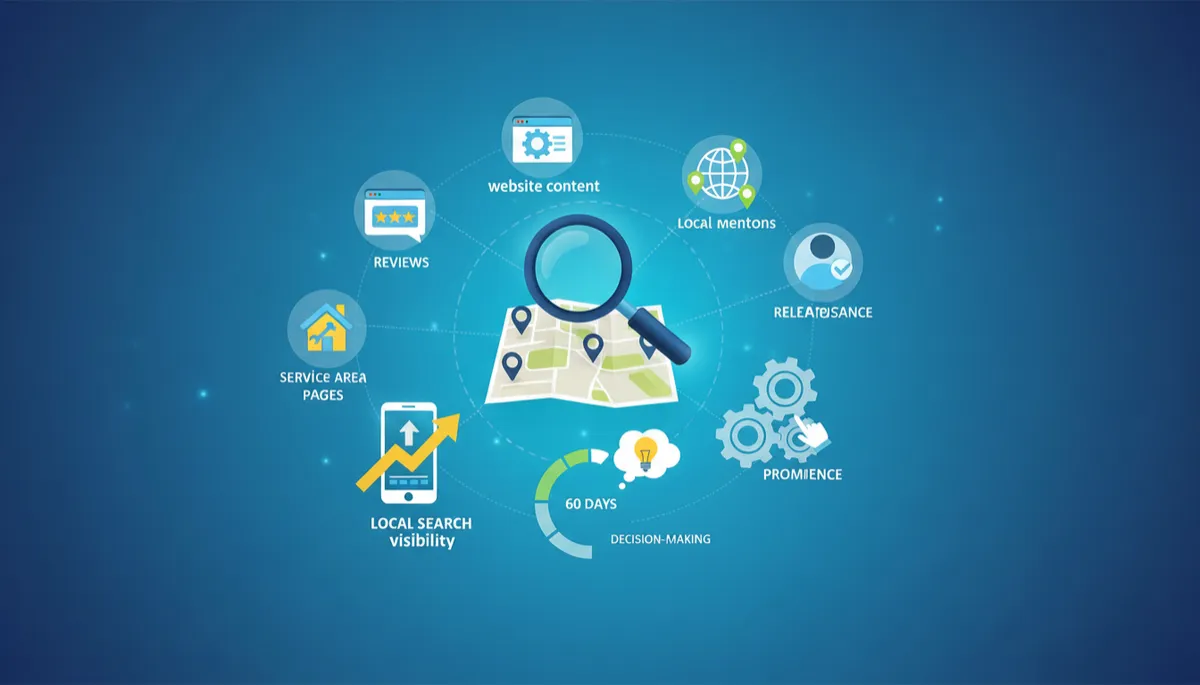
Local SEO can absolutely help you get found more often by the right people. By aligning your website content, reviews, local mentions, service area pages, and Google Business Profile with Google’s ranking factors—relevance, distance, and especially prominence—you can influence how often you appear and how strong you look when you do.
But visibility alone doesn’t guarantee a better business. If your local SEO brings in more of the wrong jobs—low-margin, high-hassle work—you’ve just created more complexity without more freedom. That’s the opposite of what we stand for at Leon Beeloo. The real win is when your visibility supports the right mix of jobs, margins, and customers, so growth leads to more profit and less owner dependence, not the other way around.
Next Step: Use the Profit Acceleration Assessment to Decide What to Prioritize
Before you push harder on local SEO, it’s worth asking: Which services and jobs deserve more visibility? That’s where the Profit Acceleration Assessment comes in. Bring three numbers—your annual revenue, gross margin, and operating profit—and in about 45 minutes we’ll help you uncover where additional profit opportunities may already exist inside the business you’ve built.
You’ll walk away with a personalized Profit Acceleration Roadmap that shows:
Which services and job types should be your priority focus for local SEO and sales efforts.
Where your margins are strong—and where they quietly leak profit and owner time.
What to improve first so growth creates more profitability, predictability, and freedom, not more chaos.
Local SEO is powerful when it’s built on smart business decisions. Use the next 60 days to tighten your online presence—and use the Profit Acceleration Assessment to make sure you’re shining the spotlight on the work that truly moves your bottom line and your quality of life forward.