Boost Local Business with Consistent Lead Generation
Local Business Growth, Lead Generation, Small Business Consulting
How Local Service Businesses Can Generate Quality Leads Consistently (Without Working Harder)
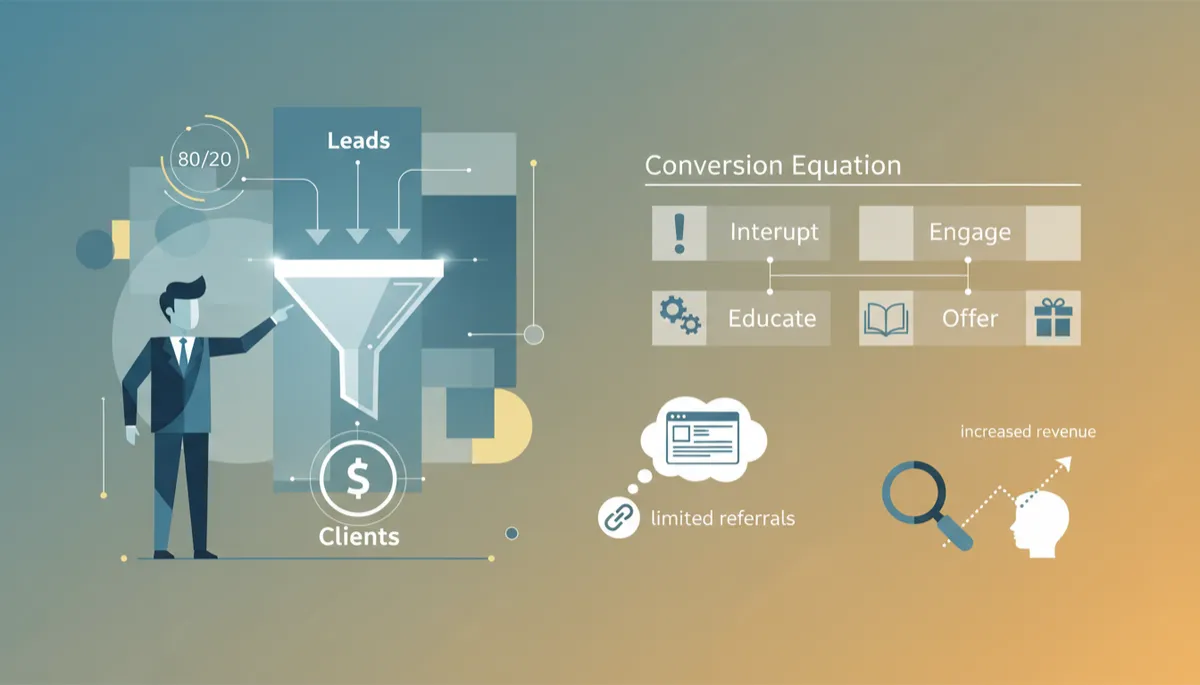
If your local business still relies mainly on word of mouth, repeat customers, and a website that quietly sits there “just in case,” you’re leaving serious profit—and freedom—on the table. In my last post, I wrote about boosting profit without adding more clients read more here. This guide shows how a structured lead-generation system, built around the 80/20 rule, a clear market-dominating position, and the Conversion Equation, can transform the business you already have into a more profitable, predictable, and less owner-dependent operation.
Why Lead Generation Is No Longer Optional for Established Local Businesses
Most established local service businesses reach their first few hundred thousand—or even a few million—in revenue the same way: the owner does great work, treats people well, and builds a strong reputation. Referrals and repeat business follow. For a while, that’s enough. Then growth stalls, complexity increases, and the owner finds themselves working harder for marginal gains in profit and freedom.
At that point, the problem usually isn’t the service you deliver. It’s the lack of a deliberate, repeatable way to generate quality leads—leads you can turn on and off, measure, and improve. Without that, your business is exposed to forces you don’t control: a key referral partner retires, a competitor gets aggressive, the economy tightens, or your personal capacity to “network harder” simply runs out.
📌 Key Takeaway: If your business cannot reliably create new conversations with qualified prospects every week—without you having to chase them—you don’t have a growth engine, you have a hope strategy.
The Hidden Cost of Relying Only on Referrals and a Passive Website
Referrals feel great. They come pre-sold, they trust you, and they often become excellent long-term clients. The problem is volume and control. You cannot decide to “get 12 good referrals this month” and make it happen on command. You’re dependent on other people remembering you, having the right conversation at the right time, and then actually making the introduction. That’s not a system; it’s luck dressed up as loyalty.
The same applies to websites that don’t convert. Many local businesses have invested money into a “nice-looking” site that functions like an online brochure: logo at the top, generic slogan, list of services, and a contact form buried at the bottom. It might make you feel more professional, but if it doesn’t turn visitors into leads, it’s not an asset—it’s overhead. Traffic without conversion is just digital foot traffic walking past your door.
💡 Pro Tip: Measure how many website visitors turn into actual inquiries or calls. If you don’t know that number—or it’s embarrassingly low—you have a conversion problem, not just a traffic problem.
How a Business Consultant Systematically Attracts Quality Customers
At Leon Beeloo, the goal is not to “do more marketing” for the sake of activity. The goal is to build a simple, measurable lead-generation system that increases profit and reduces owner dependence. The process typically follows five practical steps you can adapt to your own business:
Clarify who your best customers really are. Not everyone you could help—only the ones who are most profitable, easiest to serve, and most likely to value what you do. This is where the 80/20 rule starts to matter.
Create a market-dominating position. This is a clear, compelling promise that explains why your ideal customer should choose you instead of any other option, including doing nothing. It becomes the foundation of your messaging everywhere: website, ads, emails, and conversations.
Apply the Conversion Equation. Every marketing touchpoint is redesigned around four elements—Interrupt, Engage, Educate, and Offer—so it grabs attention, builds interest, and leads to a specific next step instead of vague “learn more” buttons.
Build compelling offers and follow-up systems. You stop asking people to “call for a consultation” and instead give them a low-risk, high-value next step that feels obvious. Then you follow up consistently with those who raise their hand but aren’t ready yet.
Measure, refine, and systemize. Once the pieces are in place, you track the numbers, improve the weakest link, and document the process so it doesn’t depend on you remembering to “do more marketing” when things get slow.
This is not theory. It’s a practical approach that consistently uncovers hidden profit in businesses already doing $500K–$5M in revenue—without demanding that the owner work more hours or become a full-time marketer.
The 80/20 Rule: Focus on the Few Activities That Drive Most of Your Leads and Profit
The 80/20 rule (also known as the Pareto Principle) says that roughly 80% of your results come from 20% of your efforts. In a local service business, that often looks like:
20% of your customers generate 80% of your profit.
20% of your services are responsible for 80% of your revenue.
20% of your marketing activities generate 80% of your best leads—if you track them.
When Leon Beeloo works with owners, one of the first moves is to identify those “vital few” customers, services, and marketing channels that actually matter. Instead of trying to be everything to everyone, you double down on what your best clients value most and design your lead-generation system around that narrow, profitable slice of the market. This is how growth becomes more profitable and more predictable—without adding unnecessary complexity.
📌 Key Takeaway: Lead generation becomes far easier when you stop chasing every possible prospect and focus on the specific 20% who already value and pay well for what you do best.
Creating a Market-Dominating Position: Why Should They Choose You?
Most local business websites and brochures sound interchangeable: “We provide quality service at a fair price. We care about our customers. We’ve been in business for 20 years.” Those statements might be true, but they don’t give a prospect any concrete reason to choose you over the competitor down the street—or to act now instead of later. A market-dominating position changes that by making a clear, specific promise that addresses a problem your ideal customer urgently wants solved.
For example, instead of “Experienced Child Psychologist in Townsville,” a stronger market-dominating position might be: “We help anxious and overwhelmed children reduce meltdowns and sleep better in 90 days—without relying solely on medication.” That statement is specific, outcome-focused, and clearly different from generic “counselling services.” It speaks directly to the worries of a particular type of parent and positions the psychologist as the obvious choice for that problem.

A clear, problem-focused promise can double or triple response from the same traffic.
Your own market-dominating position should answer three questions in your ideal customer’s mind:
What problem do you solve better or differently?
What outcome can they reasonably expect?
Why should they believe you? (proof, process, or guarantee)
Once this is clear, every piece of lead-generation—ads, website, emails, scripts—becomes sharper and more effective. You’re no longer selling “services”; you’re offering a specific, valuable solution to a clearly defined problem.
The Conversion Equation: Interrupt, Engage, Educate, Offer
Even with a strong market-dominating position, you still need a structure that turns a distracted prospect into a lead. That’s where the Conversion Equation comes in: Interrupt, Engage, Educate, and Offer. Used correctly, it can dramatically increase the number of qualified leads you generate from the same advertising budget or website traffic.
1. Interrupt: Get the Right Prospect’s Attention
The interrupt is usually your headline or opening statement. Its job is not to sell—it’s to make your ideal prospect stop and think, “That’s me.” For the child psychologist, an interrupt might be: “Is Your Child’s Anxiety Turning Bedtime into a Nightly Battle?” A parent living that reality will immediately pay attention. Everyone else will keep scrolling, which is fine—you only want to interrupt the people you’re best suited to help.
2. Engage: Deepen Their Interest with a Subheadline
Once you have their attention, the engage step reassures them that reading further is worth their time. It usually sits directly under the headline. Continuing our example: “Discover a proven, family-friendly approach to reduce meltdowns and help your child feel calmer—often in 90 days or less.” Now the parent knows you understand their problem and have a specific, time-bound solution. Curiosity increases. They’re ready to learn more.
3. Educate: Explain, Don’t Hype
Education is where you differentiate yourself and build trust. Instead of vague claims, you explain what’s really going on with their problem and how your approach addresses it. For the psychologist, this might mean briefly explaining why some children respond poorly to certain strategies, or why involving parents in the process leads to better outcomes. In your business, it might be walking prospects through the hidden costs of a common mistake you help them avoid.
💡 Pro Tip: The more you educate, the less you have to “sell.” Prospects who understand the problem and your approach are far more likely to choose you and far less likely to haggle on price.
4. Offer: A Clear, Low-Risk Next Step
Finally, you present an offer—a specific action you want the prospect to take that feels safe, valuable, and easy to say yes to. This is where most local businesses fall flat. “Contact us” or “Schedule a consultation” is not compelling. It’s vague, high-commitment, and puts all the pressure on the prospect to figure out what happens next.
A better offer for the child psychologist might be: “Download our free ‘7-Day Bedtime Reset Plan’ to help your child fall asleep faster, with fewer meltdowns—created by a licensed child psychologist.” Or: “Book a 20-minute ‘Calmer Evenings’ phone consult to identify what’s really driving your child’s anxiety and the best next step.” Both offers are clear, specific, and valuable—even if the parent never becomes a client. That’s what makes them compelling.
From Generic Website to Lead-Generating Squeeze Page: The Child Psychologist Example
Consider a real-world style scenario. A child psychologist has a standard website: home, about, services, contact. The homepage headline reads, “Professional Child and Adolescent Psychology Services.” There’s a stock photo of a smiling family, a list of conditions treated, and a phone number in the header. Traffic trickles in from Google and referrals, but very few visitors actually call. Parents browse, feel overwhelmed, and leave without taking action.
Working with a consultant, the psychologist creates a simple squeeze page—a focused landing page with one goal: capture contact details from interested parents. The page is built around the Conversion Equation:
Interrupt: “Is Your Child’s Anxiety Turning School Mornings into a Daily Struggle?”
Engage: “Get our free ‘Morning Calm Checklist’ used by parents to ease anxiety, reduce tears, and get out the door on time.”
Educate: A short explanation of why certain common approaches backfire and three simple strategies that work better, written in plain language.
Offer: “Enter your email to get the checklist instantly and receive our weekly ‘Calmer Kids’ tips from a licensed child psychologist.”
Suddenly, instead of 100 anonymous website visitors per month and one or two hesitant calls, the psychologist is capturing 20–30 email addresses from highly qualified parents. Over the next few weeks, those parents receive a short, educational email sequence: stories, tips, and invitations to a low-risk introductory consult. Even if only a fraction book a session, the psychologist has turned a passive website into a predictable lead pipeline—using the same or less traffic than before.
Compelling Offers and Follow-Up: Where Most Local Businesses Leave Money on the Table
The child psychologist example highlights two critical elements that apply to every local service business: compelling offers and consistent follow-up. Most owners underestimate how many of their “almost” prospects simply weren’t ready yet—and how many would have become clients with a thoughtful follow-up system in place.
A compelling offer gives them a reason to raise their hand now, even if they’re not ready to buy. It might be a checklist, short guide, introductory assessment, or first-visit incentive—something that solves a small piece of their problem immediately.
A follow-up system nurtures those leads over days, weeks, or months, so when they are ready, you’re the obvious and only choice they seriously consider.
In practical terms, that might look like a simple email sequence, a scheduled follow-up call from your team, or a quarterly “check-in” message. The key is that it’s documented, delegated, and measured—not dependent on you remembering to “circle back” with people when you have a spare moment.
Putting It All Together in Your Own Business
If you’re an established local business owner with 5–15 employees and a solid reputation, you don’t need a flashy brand overhaul or a dozen new marketing channels. You need a clear, focused lead-generation system that:
Targets the 20% of customers and services that drive most of your profit.
Communicates a strong market-dominating position in plain language your prospects instantly understand.
Uses the Conversion Equation—Interrupt, Engage, Educate, Offer—on your website, landing pages, and key marketing pieces.
Includes at least one compelling, low-risk offer and a documented follow-up process that your team can run without you.
When these elements are in place, you move from unpredictable, owner-driven growth to a more profitable, predictable, and self-sufficient business. You’re no longer at the mercy of random referrals or a website that looks nice but quietly wastes opportunity. Instead, you have a system that consistently creates qualified conversations with the kinds of customers you most want to serve.
Your Next Step: Uncover the Lead and Profit Opportunities Hiding in Your Existing Business
You’ve already done the hard part: building a real business, earning a reputation, and serving customers well. The opportunity now is to make that business work harder for you—so revenue, profit, and freedom grow together, instead of pulling in opposite directions. That starts with seeing where your biggest, fastest opportunities for improvement really are, not guessing or chasing the latest marketing trend.
With Leon Beeloo, that begins with a focused, numbers-based conversation: the Profit Acceleration Assessment. Bring three numbers—your annual revenue, gross margin, and operating profit—and in about 45 minutes we’ll map out where additional profit and lead-generation opportunities may already exist inside the business you’ve built. You’ll walk away with a personalized Profit Acceleration Roadmap that highlights what deserves attention, what to fix first, and how to align your lead-generation system with your long-term goals for profit and freedom.
📌 Key Takeaway: You don’t need more chaos, more complexity, or more random marketing experiments. You need a simple, proven process to attract better leads, convert them more effectively, and build a business that no longer depends on you for every decision and every new customer.
If you’re ready to turn your existing reputation and customer base into a more reliable growth engine, start by taking the Profit Acceleration Assessment. It’s a practical, grounded way to see how the 80/20 rule, a stronger market-dominating position, and the Conversion Equation can work together in your specific business—so you can generate better leads, earn better margins, and gain more control over how you spend your time.