Boost Revenue with Bundling Strategies
Bundling, Increase Revenue, Business Scalability
Bundling, The Overlooked Profit Accelerator
You do not need more chaos, more custom one-off jobs, or another “big idea” that quietly erodes your margins. You need more profit and more freedom from the day-to-day. For most established, owner-dependent service businesses, one of the fastest ways to get both is hiding in plain sight: bundling the work you already do into clear, repeatable offers.
When it is done correctly, bundling turns scattered services into simple, compelling packages your team can confidently sell and deliver. It raises the average value of every customer, protects your margins, and reduces how often your business needs your personal judgment just to keep moving. In other words, bundling is a practical way to increase revenue, improve profitability, and move toward real scalability using the business you have already worked so hard to build. For a deeper dive into protecting profitability, see how to protect your margins while you grow.
Why Bundling Matters for Owner-Dependent Businesses
If you run a service-based business generating $500K–$5M in annual revenue, there is a good chance your success has been built on your personal expertise, relationships, and willingness to solve almost any problem for a customer. That flexibility helped you grow. It is also a major reason your business still depends heavily on you today.
Every custom quote, special exception, and one-off solution requires your judgment. Your team cannot confidently price or scope work without you. As revenue grows, so does the complexity, and your involvement. This is where bundling becomes a powerful, often overlooked profit accelerator. Instead of selling one-off tasks, you package related services into clear, pre-defined bundles that deliver a specific outcome at a defined price and scope. That simple shift changes how you sell, how you staff, and how you scale.
What Is Bundling, Really?
In practical terms, bundling means grouping complementary products or services into a single, clearly defined offer with a combined price. Instead of selling line items, “two hours of design,” “onsite consultation,” “filter replacement,” “follow-up visit,” you sell a package that solves a problem or delivers a result. For example:
A marketing agency might bundle strategy, campaign setup, monthly reporting, and optimization into a “Local Growth Package” instead of quoting each task separately.
An HVAC company might bundle seasonal maintenance, priority service, and discounted repairs into an annual “Comfort Care Plan.”
An IT services firm might bundle monitoring, security updates, backups, and helpdesk support into a “Business Protection Bundle.”
The customer is not buying hours or tasks; they are buying a solution. That shift is at the heart of how bundling helps you increase revenue and move toward true business scalability.
How Bundling Helps You Increase Revenue Without More Chaos
1. Raising Your Average Transaction Value
One of the most direct ways bundling helps you increase revenue is by raising the average value of each sale. When you package complementary services together, you make it easier for customers to say “yes” to a more complete solution instead of a minimal, stripped-down option. For example, a stand-alone service call might be $250. A “Total System Tune-Up Bundle” at $495 that includes inspection, cleaning, minor parts, and a follow-up visit often feels like a better decision to the customer, and delivers more revenue per job for you.
Because the bundle is framed around value and outcomes, not hours, you are less likely to get pulled into price-by-line-item negotiations. You protect your margins while genuinely improving the customer’s experience. Over time, small increases in average transaction value compound into meaningful profit growth, without requiring more leads, more advertising, or more owner-driven selling.
2. Improving Margin and Reducing Discount Pressure
When you sell individual services, customers can easily compare line-item prices with competitors. That pushes you toward discounts and price matching. Bundling changes the conversation. You are no longer selling a commodity hour or task; you are selling a curated solution that is harder to compare directly. That gives you more pricing power and room to protect your gross margin.
Well-designed bundles also allow you to cross-subsidize. Higher-margin services can offset lower-margin components, leading to a stronger overall profit profile. Instead of discounting to “win the job,” you design bundles that feel like a clear win for the customer while quietly strengthening your economics in the background. This aligns directly with Leon Beeloo’s commitment to never sacrificing long-term business health for short-term wins.
3. Increasing Recurring and Predictable Revenue
Bundling is also a powerful tool for creating recurring revenue. Instead of selling one-off projects, you can design ongoing bundles, monthly, quarterly, or annual plans, that include maintenance, reporting, optimization, or priority access. This steadier revenue base improves cash flow, makes planning easier, and reduces the constant pressure to chase the next job just to keep the doors open.
Predictable revenue is a cornerstone of business scalability. It allows you to staff more confidently, invest in better systems, and step out of “emergency mode” decision-making. Bundling recurring services around what your best customers already need is one of the most practical ways to move in that direction.
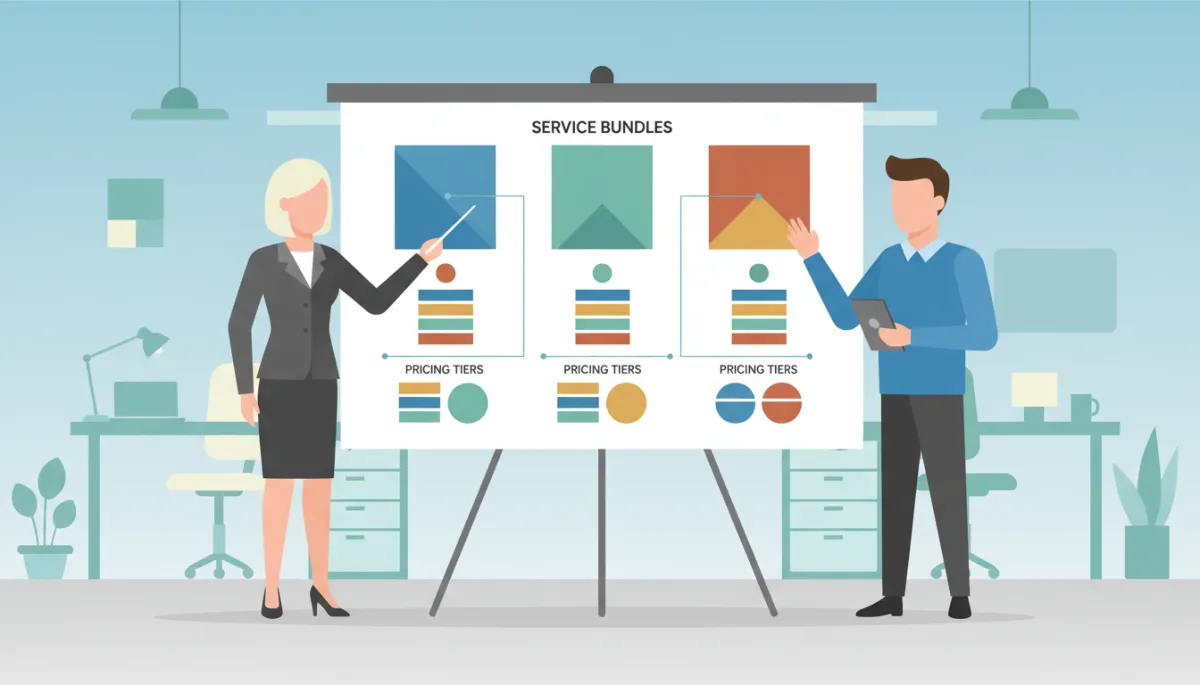
Clear bundles turn complex services into repeatable offers your team can sell and deliver.
Bundling as a Foundation for Business Scalability
Most owner-dependent businesses do not struggle because they lack opportunity. They struggle because every opportunity requires the owner’s direct involvement to quote, sell, and deliver. Bundling is a practical way to break that pattern and build a business that can grow without consuming more of your time and attention.
1. Standardizing What You Sell
You cannot scale what is undefined. Bundling forces you to clarify what is included, what is not, and what outcome each offer is designed to deliver. That clarity is the starting point for building systems, training your team, and holding people accountable. When you have three or four core bundles instead of dozens of custom configurations, it becomes far easier to create checklists, workflows, and quality standards around each one.
For example, a “Premium Maintenance Bundle” can have a standard 10-step process, expected labor hours, and required materials. Your team knows what “done right” looks like. You can measure performance, coach to a standard, and gradually remove yourself from daily oversight without sacrificing quality.
2. Making Sales Less Dependent on the Owner
In many established local businesses, the owner is still the best, and sometimes the only, effective salesperson. That is not sustainable. Bundling gives your team something concrete and confident to sell. Instead of building every proposal from scratch, they can present a small menu of bundles aligned to typical customer needs, with clear pricing and benefits already defined.
This reduces the number of decisions that require your input. It also shortens the sales cycle and improves consistency. Over time, your role can shift from “chief closer” to “coach and strategist,” which is exactly the transition Leon Beeloo helps owners make, moving from indispensable operator to true business owner.
3. Simplifying Operations and Capacity Planning
When every job is different, scheduling and staffing become guesswork. Bundling creates patterns. If you know that a particular bundle generally requires eight labor hours, specific materials, and one follow-up, you can plan capacity and inventory with far more confidence. That leads to better utilization of your team, fewer last-minute surprises, and less firefighting on your part.
This operational stability is a core element of business scalability. Growth stops being a series of stressful leaps and becomes a controlled, predictable process where systems and people can keep up with demand.
Common Objections to Bundling, and How to Address Them
“My Business Is Too Custom for Bundles.”
Many owners believe their work is so specialized that bundling is impossible. In reality, even highly customized businesses usually have patterns. You may have three or four types of projects that repeat, even if every job has unique details. Bundling does not eliminate customization; it organizes your most common work into clear starting points that your team can understand and sell, while still allowing room for tailored add-ons when necessary.
“Customers Will Think I’m Just Trying to Sell Them More.”
When bundling is done poorly, it can feel like that. When it is done well, bundles actually make buying easier and less stressful for your customers. They do not have to guess which services they need or worry about being surprised by add-ons later. A thoughtfully designed bundle says, “We understand your situation. Here is a complete solution that covers what you actually need.” That clarity builds trust and often leads to stronger, longer-term relationships.
“Won’t I Lose Flexibility?”
You may lose some of the improvisation that currently requires your constant involvement, but that is exactly the point. Bundling is not about rigid rules; it is about creating a standard way of doing your most important, profitable work. You can still allow exceptions when they truly make sense, but they become the exception, not the default. The result is more control, more predictability, and more freedom to decide where your time is best spent.
A Practical Framework to Start Bundling in Your Business
Step 1: Identify Your Most Common, Profitable Work
Look back over the past 6–12 months. Which types of jobs or projects show up again and again? Which customers are the most profitable and least stressful to serve? Start your bundling strategy there. The goal is not to capture every possible scenario; it is to focus on the 60–80% of work that already follows recognizable patterns and contributes meaningfully to profit.
Step 2: Define the Outcome, Not Just the Tasks
Customers care about outcomes: fewer breakdowns, more leads, better visibility, faster response times. When you design a bundle, start by clearly stating the outcome it delivers. Then work backward to decide which services, steps, and support elements need to be included to reliably produce that outcome. This keeps your bundles focused on value, not just a list of activities.
Step 3: Set Clear Inclusions, Exclusions, and Pricing
Next, define what is included in the bundle, what is not, and how it is priced. This is where you protect your margins and your time. Be specific enough that your team can explain it confidently and your customers can understand it easily. When appropriate, consider offering three tiers, basic, standard, and premium, to guide customers toward the level of support that best fits their needs and budget while helping you increase revenue per relationship.
Step 4: Build Simple Delivery Checklists and Scripts
Once your bundles are defined, create basic checklists for delivery and simple scripts or talking points for sales conversations. These do not need to be perfect on day one. The objective is to give your team enough structure to start selling and delivering without you in every conversation. As you learn what works, you can refine the documentation and improve your systems over time, another step toward real business scalability.
Step 5: Monitor Results and Adjust Intentionally
Finally, track how your bundles perform. Which ones sell most often? Which deliver the best gross margin? Where are you seeing scope creep or confusion? Use this information to refine your offers, tighten your definitions, and adjust pricing where needed. This practical, data-informed approach aligns with Leon Beeloo’s emphasis on measurable, sustainable progress over hype or quick fixes.
Bundling, Profit, and Your Role as the Owner
At its core, bundling is not just a pricing tactic. It is a strategic tool for reshaping how your business creates value, how your team operates, and how you, as the owner, spend your time. When your offers are clear, your pricing is structured, and your delivery is standardized, you gain leverage. You can focus more on leadership, strategy, and building an accountable team, and less on quoting every job, solving every problem, and rescuing every customer situation personally.
That is the real promise of bundling for established, owner-dependent businesses: stronger profitability, more predictable revenue, and a path toward a company that does not rely on you for every decision. It is one of the most direct ways to align growth with the freedom and control you wanted when you started your business in the first place.
📌 Key Takeaway: Bundling helps you increase revenue, protect margins, and build a more scalable, less owner-dependent business by turning scattered services into clear, repeatable offers your team can confidently sell and deliver.
Take the Next Step: Explore Bundling in Your Own Business
Reading about bundling is helpful. Applying it inside your specific business, with your services, your customers, and your numbers, is where the real value is created. That is why Leon Beeloo offers the Monday Small Business Mentorship, a focused weekly strategy session designed for established local owners who want to build a more profitable, predictable, and self-sufficient company without adding more complexity or owner dependence.
Each week, we take a practical, no-fluff look at strategies like bundling, pricing, systems, marketing, sales, and team accountability, always grounded in what will genuinely improve the business you have already worked so hard to build. You will see how to design bundles that fit your market, protect your margins, and support real business scalability, not just short-term revenue spikes.
If you are ready to explore how bundling can become a profit accelerator in your own business, and how it fits into a broader plan to reduce owner dependence and strengthen your systems, join the Monday Small Business Mentorship for a deeper dive. You can learn more and reserve your spot at https://pembrokeconnections.com/weeklystrategy .
Conclusion: Turn Bundling into a Concrete Profit Strategy
Bundling is not theory. It is a practical, repeatable way to turn the services you already deliver into clearer offers that increase revenue, protect your margins, and reduce owner dependence. By standardizing what you sell, simplifying how your team delivers it, and creating more recurring, predictable work, you move closer to a business that grows without demanding more of you in return.
In short, when you bundle effectively, you:
Raise average transaction value by packaging complete solutions instead of isolated tasks.
Protect and improve margins by shifting the conversation from price-per-line-item to value and outcomes.
Build real scalability through standardized offers, clearer systems, and a team that can sell and deliver without you in every decision.
💡 Pro Tip: You do not need a dozen bundles to start. One or two well-designed, profitable bundles aimed at your best customers can create meaningful gains in revenue, predictability, and owner freedom.